 |
Syllabus PSYCH 3104/5104 9:00 MWF Sabin 25 Dr. Linda L. Walsh |
 |
|
|
|
|
Syllabus PSYCH 3104/5104 9:00 MWF Sabin 25 Dr. Linda L. Walsh |
|
|
|
| PROFESSOR: | Dr. Linda L. Walsh |
| Office:
Bartlett 1075 Office Hrs:12:30-1:30 MW; 10:30-11:30 T,Th; other times by appointment; drop-bys are welcome. Mailbox: Bartlett 1068 |
|
| Phone: 273-2690 Email: walsh@uni.edu |
Blakiston's Medical Dictionary defines neurology as the study of the anatomy, physiology, and pathology of the nervous system, and the treatment of its disorders. This course will include all of these components although in a single semester, of course, we will just skim the surface of this content. We will cover the gross anatomy and organization of the nervous system, paying particular attention to the function of the component parts and systems. Unlike a traditional neuroanatomy course we will not have the opportunity to do dissections or spend time on the microscopic or detailed internal anatomy, but will instead relate neuroanatomy to the control of behavior. While most medical school courses on "neurology" are devoted almost entirely to diseases and disorders of the nervous system, we will use common neurological problems as a means of understanding normal nervous system function and making the neuroanatomy more meaningful. Since this course draws many students who hope to pursue a variety of helping professions, it is hoped that this coverage will provide the basis for understanding the neurological disorders and treatments you might encounter in your careers.
 "How much of this stuff will be on the exam?"
Resources for Neuroscience, Neurological and
Neuropsychological Terms:
Neuroscience for Kids - Glossary
NINDS
Neurological Disorder Index
Search
your disorder on Emedicine
Etymology of Neuroscience Terms
Online
Guide to the Neurological Exam
Clinical
Neuropsychology
Reference
Neurologic Exam Videos
Glossary
of Neuropsychology Terms
Online
Neuroscience Textbook
|
|
| The digital anatomist A very comprehensive site featuring pictures and 3 dimensional reconstruction of the human brain. On-line quiz on each image. (slow and shaky connection). |
| The whole brain atlas: A comprehensive atlas of 2 dimensional scans of the human brain using techniques such as CT or MRI, including normal anatomy and pathology. |
| Virtual Hospital:The Human Brain - Human brain dissections from the University of Iowa |
| The W.U.S.M. Neuroscience Tutorial - from Washington University School of Medicine |
Basic
Anatomy Homework (25 pts) Due Jan 20) Since the
students in this class come from diverse backgrounds, this
first set of assignments is to make sure everyone begins with
a basic understanding of CNS anatomy/vocabulary such as one
might get in a good Intro to Psych text. To that end, the Introductory
Reading linked to the syllabus IS from an Intro to Psych
text. That reading plus the webpages ("Explore
and
Learn the information in the
first
5
topics under "Brain Basics" ) and completing the
associated anatomy handout should give you this basic
foundation. It is also important for you to become familiar
with these components in basic diagrams of the brain and the
major "chunks" or subdivisions of the CNS. To this end please
prepare a simple 3-D brain model (Basic
Anatomy Diagram). Color the various
brain regions on the "Build a Brain" handout so that, when put
together, it will be a more vivid brain model. If a particular
structure shows up on more than one page (e.g. the thalamus),
use the same color for that structure on all pages.
Notice that in the handout assignment you are also asked to
begin to associate each structure with it best known
function(s) and what subdivision it is found in. These best
known functions are mentioned in the reading and/or the
assigned webpages.
As an example I will give you 2 answers that don't appear in
your reading:
fornix - (which is
part of the limbic system connecting to hippocampus)
telencephalon - emotion and memory (you only have to do
this once for each structure)
internal capsule
(IC)(big axon bundle carrying messages between cortex and
lower brain areas) - telencephalon - sensory messages coming
to cortex, motor commands leaving cortex
In case you can't decode my abbreviations in the brain
diagram:
BG=basal ganglia, cer=cerebellum, mid=midbrain,
hyp=hypothalamus, pg=pituitary gland
I also
encourage you to practice recognizing and labeling components
(see links next to 1/11/16 in our syllabus) .
Label Ventricular System
Due 1/25 5pts
Neuron Structure Quiz* 10 pts
Due 2/1 (label the structures covered in lecture or text)
Label Spinal Cord Cross Section 15 pts
2/13
Demonstrate Your Ability to Read
and Write About Neurology in an "Undergraduate Neurology
Update"
For this assignment
you will find, read and summarize a recent (2010 to present) research report that
advances our understanding of some human
neurological/neuropsychological condition of interest to
you. Have they found something new about the causes, the
diagnosis, the underlying nervous system pathology, or the
treatment of this condition? Begin by finding 3 research
reports you might possibly write about and submit the
abstracts or full articles to me by no later than 3/11.(15 pt) . I will
check the research reports for appropriateness. You will then
choose ONE of the approved articles to summarize. Submit your
completed summary of the research report and what you conclude
from it by 4/18. The
introduction to your paper should provide background on or our
previous understanding of the condition before you discuss the
new research. Since you are demonstrating YOUR neurology
abilities, DON'T PLAGIARIZE. Attach your article to your
paper.(85 more pts)
Demonstrate Your Ability to Read
and Write About Neurology in a "Graduate Neurology Update"
For this assignment
you will find, read and summarize 5 related recent (2010 to present) research reports
that advance our understanding of some human
neurological/neuropsychological condition of interest to
you. Have they found something new about the causes, the
diagnosis, the underlying nervous system pathology, or the
treatment of this condition? Submit the 3 abstracts or
full articles to me by no later than 3/11 to show that you have selected a topic
and begun your update (15 pt). Submit your completed
review/summary of 5 related articles and what you conclude
from them by 4/18. The
introduction to your review should provide background or
previous understanding of the condition before you discuss the
new research. Since you are demonstrating YOUR neurology
abilities, DON'T PLAGIARIZE. Attach your articles to your
paper.(110 more pts)
Optional
Assignments
Optional assignments
are additional assignments to be factored in your grade just
like required assignments. Doing extra assignments decreases
the proportion of your semester grade based on tests and
increases the proportion based on assignments. Doing optional
assignments increases the "points possible" as well as
the "points earned" in the calculation of your grade (that is,
these are not freebie extra credit points).
Create a
Brain Area, Pathway or System Model (up to 30 pts; minimum
15 anatomical regions labeled)
During the semester
we cover specific brain regions and several pathways or
interconnected systems. Your task, should you choose to accept
it, is to create a good visual model that you think could help
the class learn the underlying anatomy. Your model must be well labeled.
contain significant anatomical detail (this is meant to help
you learn required anatomy) and must be turned in while we
are covering that pathway or system. Points earned
will reflect the amount of detail, the accuracy, and the value
as an educational tool. You are encouraged to use color
coding and identifiable neuroanatomical landmarks, and to
mount or present your model in a sturdy fashion that could be
passed around class. Suggestions: detailed model of the brain
stem external features, the midline surface of the brain, detailed functional
subareas of the cortex, spinal cord and nerves in
cross-section, coronal or horizontal section of the brain, the
routes followed by the spinothalamic pathway, the dorsal
column pathway, or the corticospinal pathway. May be done
once.
10 pt Extra
Credit. Keep a blank videotape handy to record any
shows, segments, or news reports related to the
neuroanatomy/neurology covered in this class or locate a
recent relevant video link online. Turn the tape/url in to me
with a summary
of the program, why you think it's relevant to the
class, and a critical evaluation of the segment using the
linked handout.(tape will be returned). May be done once.
Grades will be based on the total number of points accumulated during the semester.**Completion of optional assignments changes the points possible for the semester. You must have a passing average on the tests to pass the course.
|
|
|
|
|
|
|
|
|
|
|
|
|
|
|
|
|
|
|
|
|
|
|
|
|
|
|
|
|
|
|
|
|
|
|
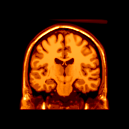
| "Gentlemen,
look on this wonder! Whatever the bids of the bidders, They cannot be high enough for it; For it the globe lay preparing quintillions of years, without one animal or plant; For it the revolving cycles truly and steadily roll'd. In this head the all-baffling brain; In it and below it, the makings of heroes." - Walt Whitman - I Sing the Body Electric, 1855 |
 |
[home] [academic
success] [careers] [grad school]
[psych
resources] [intro to psych
]
[counseling
resources][biopsych]
[drugs]
[neurology]
[TA resources]
[e-mail]
This page was
updated on 1/8/16 by Linda
Walsh